Why Do Some Cats Meow More Than Others?
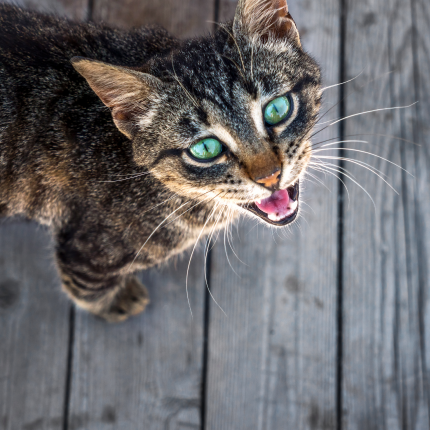
Some cats seem to have an opinion about absolutely everything. Is breakfast three minutes late? Meow. You walked into another room? Meow. You looked vaguely toward the treat cabinet? MEOW. Other cats can go practically all day without making a peep. So, why do some cats meow more than others? A cat’s personality, breed, age, environment, and even their relationship with their humans can all influence how talkative they are. And in many cases, your chatty cat may have learned that meowing is one of the best ways to communicate with you.
advertisement
Cats Mostly Meow to Communicate With Humans
One of the most interesting things about meowing is that adult cats don’t typically use it as their primary way of communicating with other adult cats. Kittens meow to get their mother’s attention when they’re hungry, cold, frightened, or need help. As cats mature, however, communication with other cats relies much more heavily on body language, scent, facial expressions, and other vocalizations.
But many cats continue meowing at humans throughout adulthood. Why? Because it works. Humans aren’t particularly talented at interpreting subtle feline signals, so cats may discover that making noise gets our attention much faster. Over time, a cat and their person can even develop their own little vocabulary of meows.
Some Cats Are Simply More Talkative
Just like people, cats have individual personalities. One cat may follow you through the house narrating their entire day, while another may prefer communicating with a slow blink or a strategically placed paw. A naturally social, confident, or attention-seeking cat may vocalize frequently because they enjoy interacting with people. A quieter or more independent cat may communicate much more subtly. Neither personality is necessarily better or healthier. Some cats are just born conversationalists.
Breed Can Make a Difference
Genetics may also play a role in how vocal a cat tends to be.
Some breeds have a reputation for being particularly talkative, including:
- Siamese
- Oriental Shorthairs
- Balinese
- Tonkinese
- Burmese
Siamese cats in particular are famous for their distinctive voices and willingness to use them. Some will seemingly hold entire conversations with their owners. Of course, breed only tells you so much. A mixed-breed cat can be extraordinarily vocal, while an individual cat from a famously talkative breed might be relatively quiet.
Your Cat May Have Trained You
We like to think we’re training our cats. Sometimes, the arrangement is very much the other way around. Imagine your cat walks into the kitchen and meows. You give them a treat. The next day, they meow again. Another treat appears. Congratulations. Your cat has discovered a button that dispenses snacks, and that button is you.
Cats are excellent at learning which behaviors produce desirable results. If meowing leads to food, petting, playtime, an opened door, or attention, your cat has every reason to keep doing it. Some cats even develop different meows for different requests. You may eventually recognize the difference between the “feed me” meow, “open this door” meow, and the extremely important “I have entered this room, and everyone needs to know about it” meow.
Hungry Cats Can Be Very Vocal
Food is one of the most common reasons cats meow. If your cat has learned when meals normally arrive, don’t be surprised if they begin reminding you before the appointed hour. Cats are creatures of routine, and some have impressively accurate internal clocks when food is involved.
Automatic feeders can sometimes reduce food-related vocalization because the cat begins associating meals with the feeder rather than the human. However, suddenly becoming ravenously hungry or significantly more vocal about food can occasionally be associated with a medical issue, particularly in older cats, so dramatic changes shouldn’t automatically be dismissed as demanding behavior.
Your Cat Might Just Want Attention
Sometimes a meow really does mean, “Hey, pay attention to me.” Cats may vocalize because they’re bored, lonely, or looking for interaction. Indoor cats especially need opportunities to play, climb, scratch, explore, and engage their natural hunting instincts.
If your cat spends much of the day alone and then becomes extremely chatty when you arrive home, they may simply be excited to have their favorite source of entertainment back. Regular interactive play sessions, puzzle feeders, climbing spaces, window perches, scratching surfaces, and rotating toys can help provide additional stimulation.
Age Can Change How Much a Cat Meows
A cat’s vocal habits can change throughout their lifetime. Kittens may vocalize frequently when seeking attention or assistance. Adult cats may develop specific vocal routines with their owners. Senior cats sometimes become more vocal than they were when younger.
Older cats may meow more because of changes in hearing or vision, discomfort, medical conditions, or cognitive changes. Some senior cats become particularly vocal at night and may seem confused or disoriented. Any significant behavioral change in an older cat is worth discussing with a veterinarian.
Stress Can Make Cats More Vocal
Changes in a cat’s environment can also affect how much they meow.
Potential stressors include:
- Moving to a new home
- Introducing another pet
- A new baby or household member
- Changes in routine
- Construction or loud noises
- Seeing unfamiliar cats outside
- Changes in access to favorite spaces
Some stressed cats become unusually quiet and hide, while others become much more vocal. Knowing what’s normal for your particular cat is more important than comparing them with someone else’s.
Why Does My Cat Meow When I Talk to Them?
If you regularly talk to your cat and they regularly answer, you may have accidentally created one of the cutest feedback loops imaginable. Your cat makes a sound. You respond. Your cat learns that vocalizing starts an interaction.
Eventually, you say, “What are you doing?” and your cat responds with a tiny mrrrow? as though this is a perfectly reasonable conversation between two adults. Your cat probably doesn’t understand your sentences the way another person would, but they can learn familiar words, sounds, routines, and tones of voice. More importantly, they learn that vocalizing gets a response from you.
When Should Excessive Meowing Be a Concern?
A talkative cat who has always been talkative usually isn’t cause for concern. What matters more is a sudden change in vocal behavior.
Contact your veterinarian if your cat suddenly begins meowing much more than usual, especially if the change is accompanied by:
- Increased thirst or urination
- Unexplained weight loss
- Increased or decreased appetite
- Vomiting or diarrhea
- Changes in litter box habits
- Difficulty moving or jumping
- Restlessness or confusion
- Hiding or other personality changes
- Signs of pain or distress
Excessive vocalization can sometimes accompany conditions such as hyperthyroidism, high blood pressure, pain, hearing loss, or cognitive decline. Your veterinarian can help determine whether there’s a medical explanation for the change.
Should You Try to Stop a Cat From Meowing?
If your cat is healthy and simply naturally talkative, there’s usually no reason to stop them from communicating. If the meowing has become disruptive, however, consider what might be reinforcing it. For example, immediately handing over a treat every time your cat screams outside the pantry can teach them that screaming is extremely effective. Instead, reward calm behavior and provide food, play, and attention on a predictable schedule.
Never punish a cat for meowing. Yelling, spraying water, or frightening them doesn’t address why they’re vocalizing and can damage their trust in you.
advertisement
The Bottom Line
Why do some cats meow more than others? Sometimes it’s genetics. Sometimes it’s personality. Sometimes they’re hungry, bored, excited, stressed, or simply want to have a conversation. And sometimes they’ve spent several years carefully studying their human and discovered that one strategically timed “meow” can make us stand up, open doors, provide snacks, throw toys, and offer immediate attention.
At that point, you have to ask yourself an uncomfortable question: Who exactly trained whom?
Search
Follow us!


Popular Posts
Featured Articles
Why Do Cats Roll Over Into Their Backs But Not Let You Touch Their Bellies?
It’s common knowledge dogs love to have their tummies rubbed when they freely lay down before you and roll onto their backs. But, if you’re also familiar with cats, you know that when they roll onto their backs with their bellies exposed, rubbing the belly will most likely result in…
Polydactyl Cats: Just More Beans to Love
Polydactyl cats have become extremely popular in recent times. As a result, more and more people are interested in learning more about this six-toed cat and want to get one of their own. If you are a cat lover intrigued by polydactyl cats, you have come to the right place….
Greebles and Cats: The Origin and the Meaning
You may have seen an internet sensation concerning cats labeled “greebles.” Feel out of the loop? We’re here to help you. In 2019, Reddit user /user/literallyatree commented on a Reddit post about a cat that looks like it’s trying to slap a ghost. This user commented: “My family calls things…