Cats and Mutual Grooming: What Allogrooming Really Means
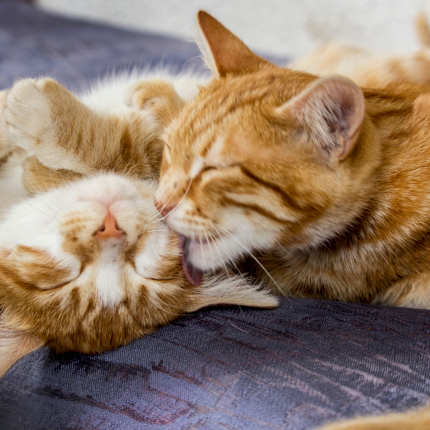
When two cats settle down and start gently washing each other’s heads, it is one of the clearest signs that they are not enemies, but friends. This behavior, called allogrooming or mutual grooming, is one of the most important pieces of “catspeak” in multi-cat households.
Contrary to some outdated claims, allogrooming is not a form of dominance. That idea largely traces back to a single study published in 1998 that was later overinterpreted and repeated as fact. More recent understanding of feline behavior paints a very different picture: mutual grooming is primarily about affection, bonding, and cooperation, not status or control.
advertisement
Why Cats Groom Each Other
When cats groom one another, they are doing much more than cleaning fur. They are:
- Reinforcing social bonds
- Building trust and security
- Reducing stress
- Caring for hard-to-reach places
Cats rarely waste effort. They do not usually groom areas that their companion could easily reach alone. Instead, mutual grooming often focuses on:
- The top of the head
- The back of the neck
- Around the ears and cheeks
These are spots that are awkward or tiring for a cat to groom on its own. So when one cat leans in and carefully washes another’s forehead or scruff, it is offering both practical help and emotional comfort.
Mother cats do this naturally with their kittens. Early grooming helps keep babies clean, stimulates their bodies, and supports their transition from relying on their mother’s body to running their own systems. Later in life, this same nurturing pattern becomes part of the adult cat’s social toolkit.
Allogrooming Is Not Dominance
For years, some sources claimed that when one cat grooms another, especially if one does more of the grooming, that cat must be “dominant.” This idea has been traced primarily to a 1998 study that suggested a link between grooming and dominance. The problem is that this single study was limited in scope, and its conclusions were generalized far beyond the data.
Modern interpretations of feline behavior and additional observational work have shown that:
- Allogrooming occurs between close companions, not just in “higher/lower” pairs.
- Cats may take turns grooming each other or specialize in different roles (one more groomer, one more groomed) without any true “boss” cat.
- Grooming often appears in peaceful, relaxed contexts, right before shared naps, after greeting, or during quiet social time, rather than around competition or resource conflicts.
In other words, while individual relationships can be complex, mutual grooming is best understood as an affiliative behavior, one that strengthens social bonds, not as a dominance display. Treating it as dominance can mislead caregivers and encourage unnecessary worry about “pecking orders” that cats themselves are not strictly following.
Grooming as a Social Message
Mutual grooming is part hygiene and part communication. A quick lick on the top of the head can say many things in “catspeak”:
- Hello, I see you.
- We’re friends; you are safe with me.
- I’m sorry / let’s keep the peace.
- Time to relax together.
In some households, one cat may use a fast, polite head lick as a kind of gentle boundary or redirection, “I am busy right now, but I still like you.” In others, it is the sleepy prelude to a shared nap, as one cat pins the other lightly with a paw and gives a thorough face wash “for their own good.”
Even more reserved cats who do not often initiate contact may allow another, more outgoing cat to groom them. That quiet acceptance is itself a powerful social signal of trust.
advertisement
When Cats Groom Their Humans
Mutual grooming is not just cat-to-cat. Many people suddenly recognize its meaning when they realize their cat is trying to groom them.
Common examples include:
- Licking or nibbling eyebrows
- Getting fixated on beards, long hair, or scarves
- Carefully washing exposed hands or arms
To a cat, these textures and locations resemble the parts of another cat they would normally groom. When a cat persistently tries to wash a person’s hair at night or fuss over a beard, it is not trying to be annoying; it is expressing deep comfort and affection with a familiar social ritual.
However, this can become a little intense for the human side of the relationship. A useful solution is gentle redirection:
- Offer a soft, fake-fur stuffed animal that mimics the feel of another cat.
- Place it nearby when grooming behavior starts, and encourage the cat to redirect onto it.
Because a stuffed toy “responds” with the right texture under the tongue and paws, it can help “close the circuit” for the cat and turn the urge into a calming, self-soothing behavior that works better for everyone.
As the cat settles into their home and gains confidence, this over-eager grooming of humans often decreases on its own.
How Humans Can “Groom Back”
Humans cannot groom like cats; there is no sandpaper tongue or fur, but there are ways to echo the comforting effect of mutual grooming:
- Pet gently on the top of the head
- Scratch lightly around the ears
- Rub or scratch under the chin or along the cheeks
These are all areas that are harder for cats to reach, and many find them especially enjoyable. This kind of touch mirrors the helpful and affectionate parts of allogrooming.
One useful approach is to let the cat guide the interaction:
- Offer a relaxed hand or a grooming tool near the head.
- Allow the cat to lean in, set the angle, and control the pressure.
When the cat chooses the contact and can pull away freely, the experience stays positive, and the human side gets to participate in a form of “social grooming” that makes sense to the cat.
Mutual Grooming Across Species
Grooming as a gesture of friendship is not just cat behavior. In many primates, mutual grooming cements alliances, comforts group members, and reduces tension. Humans do a softer version every day:
- Fixing a loved one’s collar
- Brushing lint off a friend’s jacket
- Tucking a stray lock of hair behind someone’s ear
These actions are practical but also intimate, conveying care and connection. Cats seem to understand something similar. They use mutual grooming to build what might be called a “mutual regard” system —a give-and-take of small, affectionate gestures that help their social world run smoothly.
In multi-species homes, cats often extend this system to the humans they live with. They treat their people, as much as possible, like big, slow, hairless cats:
- Bringing them gifts
- Rubbing and bunting
- Grooming when allowed
- Resting nearby or touching while they sleep
These are the feline versions of “thank you,” “I trust you,” and “you are part of my group.”
advertisement
The Game of Mutual Regard
For caregivers, understanding mutual grooming as affection rather than dominance transforms how these behaviors are perceived. Instead of worrying about hierarchies every time one cat washes another, they can recognize it as what it is: a quiet act of care.
By providing food, water, safe spaces, and gentle touch, humans build what might be called a “favor bank” with their cats, reliable, loving support that makes cats feel secure. In return, cats offer their own currency:
- Greeting at the door
- Choosing to rest close by
- Soft blinks, purrs, and grooming attempts
When both sides learn to read these gestures, the household becomes a shared game of mutual regard. The humans provide for their cats’ needs; the cats respond in their own language of affection. Everyone benefits.
And the next time two cats lean together, and one carefully licks the other’s head, observers can drop the outdated “dominance” narrative and see it for what it truly is: friendship, trust, and the deep comfort of being part of a family.
Search
Follow us!


Popular Posts
Featured Articles
Greebles and Cats: The Origin and the Meaning
You may have seen an internet sensation concerning cats labeled “greebles.” Feel out of the loop? We’re here to help you. In 2019, Reddit user /user/literallyatree commented on a Reddit post about a cat that looks like it’s trying to slap a ghost. This user commented: “My family calls things…
Why Do Cats Roll Over Into Their Backs But Not Let You Touch Their Bellies?
It’s common knowledge dogs love to have their tummies rubbed when they freely lay down before you and roll onto their backs. But, if you’re also familiar with cats, you know that when they roll onto their backs with their bellies exposed, rubbing the belly will most likely result in…
Polydactyl Cats: Just More Beans to Love
Polydactyl cats have become extremely popular in recent times. As a result, more and more people are interested in learning more about this six-toed cat and want to get one of their own. If you are a cat lover intrigued by polydactyl cats, you have come to the right place….